GDPR-Compliant Dictation Software: What Actually Matters
GDPR-compliant dictation software explained: what the GDPR requires for speech recognition, why local processing solves it, and how to spot a compliant solution.
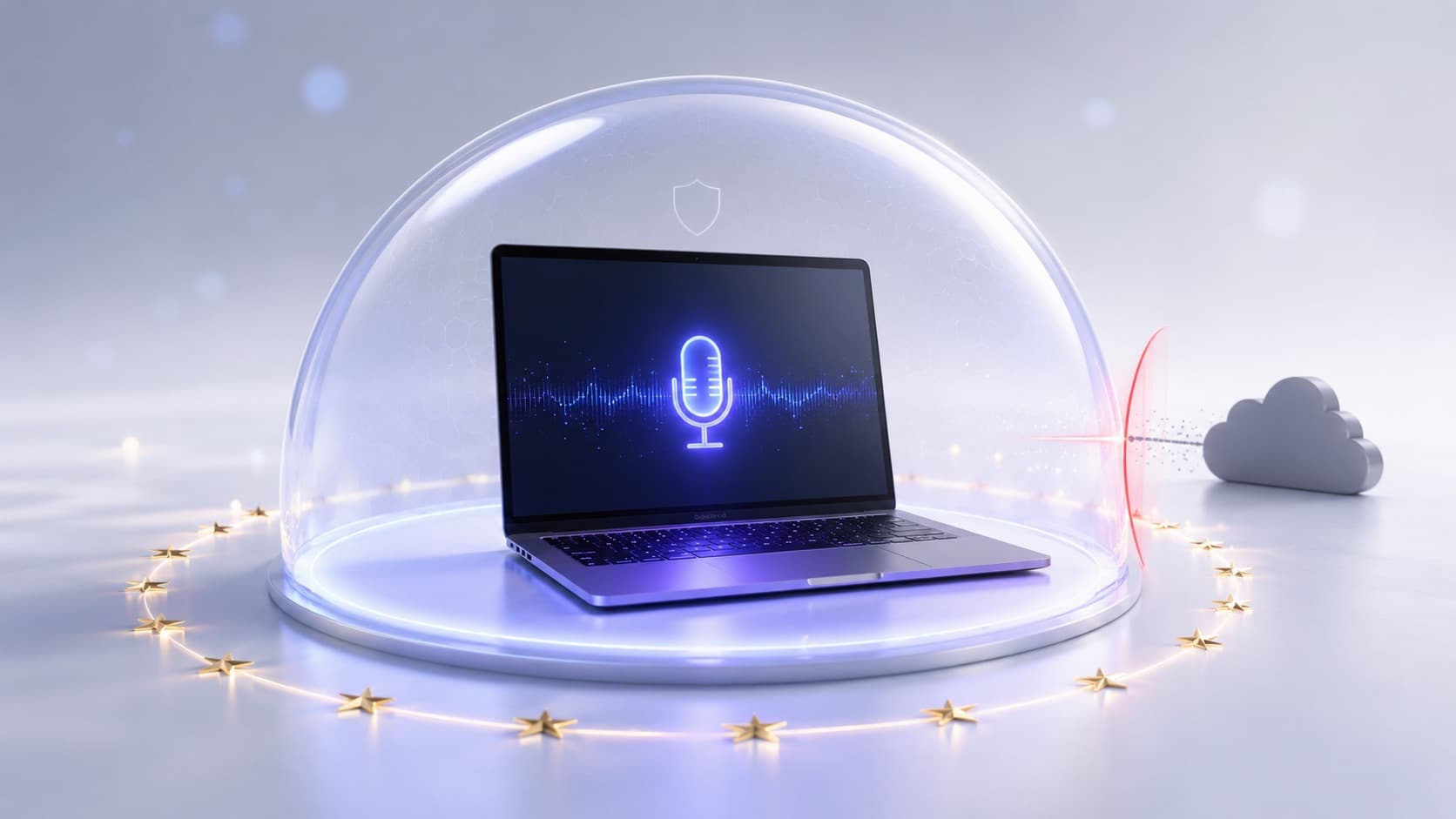
You dictate a patient note, a memo about a case, or a few internal thoughts on next quarter's strategy. The moment your voice travels to a cloud server, it becomes a privacy matter. Speech is rarely neutral: your dictations contain names, diagnoses, contract details, in short, personal data. And as soon as that is in play, the GDPR applies.
The uncomfortable part: most dictation tools quietly send your audio to servers, often outside the EU. For anyone who works with confidential content professionally, that is not a detail but a real risk. This article shows you what the GDPR actually requires of dictation software, why local processing solves the problem at the root, and how to recognize a genuinely compliant solution.
One note up front: this is general guidance, not legal advice. The concrete assessment always depends on your specific use case. If you are looking at transcribing recordings such as interviews or voice memos rather than live dictation, you will find the matching breakdown in our article on GDPR-compliant transcription software.
Why Dictation Is a Privacy Matter at All
Speech recognition processes two sensitive things at once. First, the content: the transcribed text almost always contains personal data, sometimes even special categories under Art. 9 GDPR, such as health data in a medical practice. Second, the voice itself: a voice recording is a biometric trait and therefore worth protecting on its own.
As long as both stay on your device, the situation is manageable. It gets critical the moment that data leaves your device and lands with a service provider. That is exactly when the questions the GDPR puts to you start to matter.
What the GDPR Requires of Dictation Software
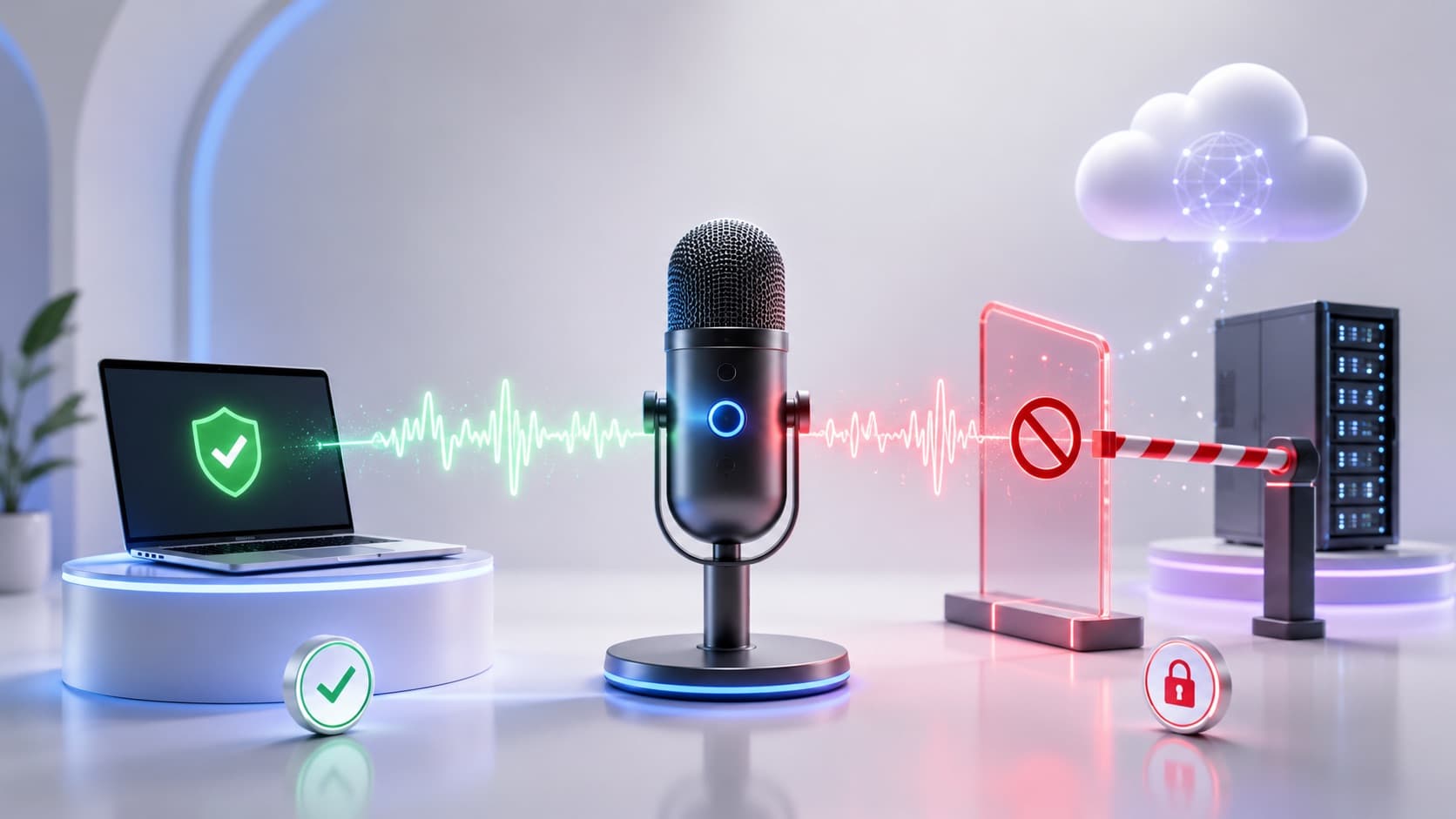 Illustrative image, AI-generated
The good news is that the GDPR is not secret science. The bad news: with cloud-based dictation, the obligations add up quickly.
As soon as a provider processes your audio data on your behalf, you usually need a Data Processing Agreement under Art. 28 GDPR. Without it, the use is formally vulnerable, even if the provider works in a technically clean way.
If the server sits outside the EU, the topic of third-country transfers is added. Since the Schrems II ruling, transfers to the US in particular are delicate, because the protection level there is considered not equivalent. You would have to check and document additional safeguards, and even then a residual risk remains.
On top of that come the information obligations under Art. 13 and 14 GDPR, the transparent disclosure of who receives the data. You have to uphold the principle of data minimization, put the appropriate technical and organizational measures in place, and depending on the risk even run a Data Protection Impact Assessment. Each of these obligations is manageable on its own. In sum, though, they create an effort that grows with every cloud connection.
Why Local-First Solves the Problem at the Root
This is the decisive lever. If speech recognition runs directly on your device, many of the obligations above become moot, simply because no data is transferred to a third party.
No data transfer means: you do not need a Data Processing Agreement for this step, there is no third-country transfer, the Schrems II question does not arise, and your information obligations get lighter because there are no additional recipients. You satisfy data minimization almost by design, because the content never leaves the device. That is exactly what makes local speech recognition the most privacy-friendly option currently available. You can read more about the basics of local solutions in our guide to offline dictation software for Mac & Windows.
The honest framing matters: local alone does not make you automatically and fully compliant. Your general obligations around endpoint security remain, that is disk encryption, access control, and backups. But the overall picture becomes dramatically easier to manage.
What If You Do Need Cloud Power?
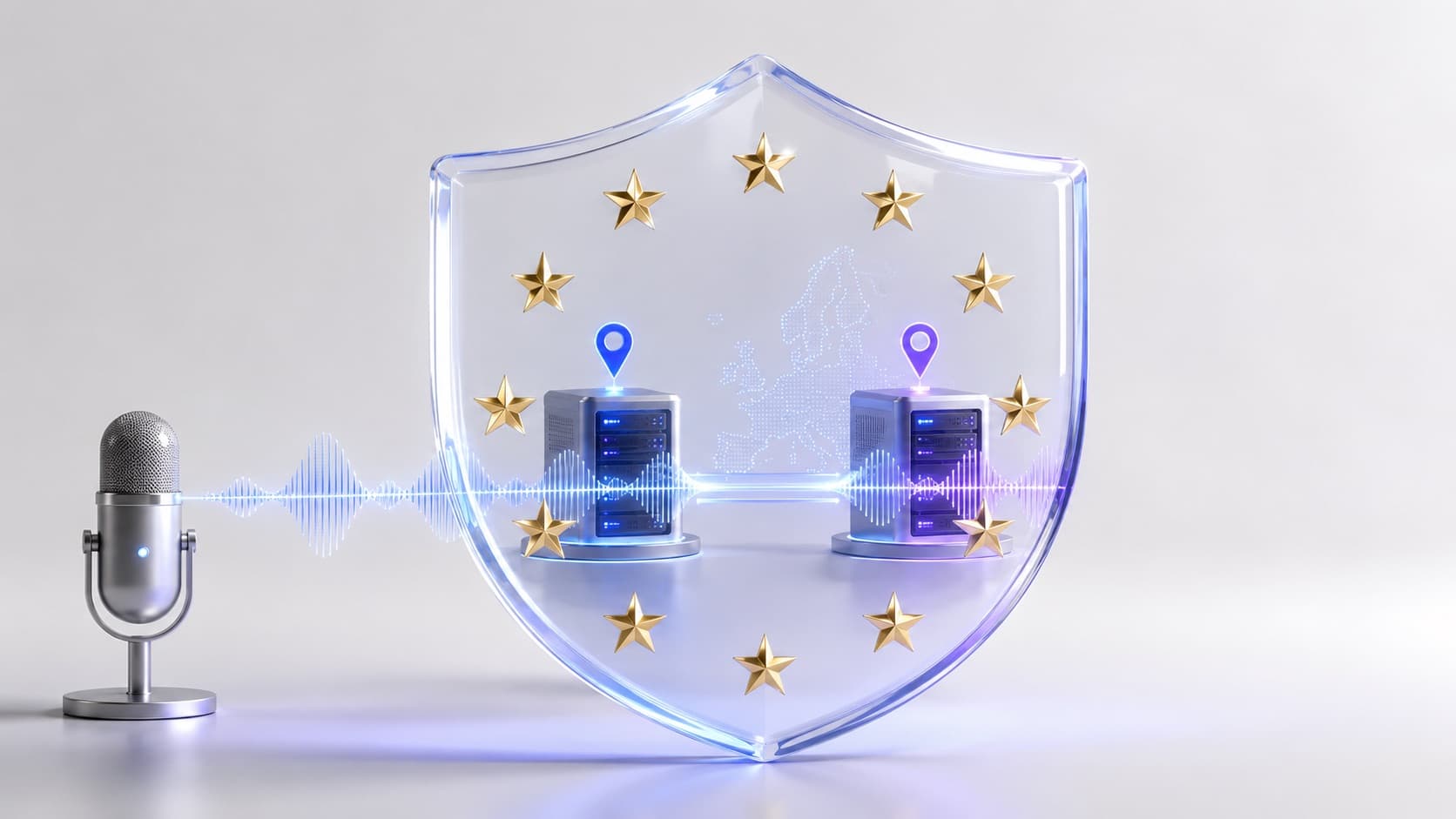 Illustrative image, AI-generated
Sometimes local compute is not enough, for example for very fast transcription on older hardware or for AI-assisted post-processing. Then the question is not "cloud yes or no", but which cloud.
A cloud is privacy-friendly when it runs exclusively through European subprocessors, a Data Processing Agreement is available, and it is transparently documented who is involved in what. That way processing stays within the EU and the tricky third-country transfer is avoided. It is also crucial that you can control whether anything goes to the cloud at all.
Checklist: How to Recognize GDPR-Compliant Dictation Software
A few points separate a serious tool from a solution that merely sounds "privacy-friendly". Make sure transcription runs locally by default, not only after tedious configuration. Check where it is hosted if a cloud is involved, ideally exclusively in the EU. Ask whether a Data Processing Agreement is available and whether the subprocessors are transparently listed.
Equally important is what happens in the background. A compliant solution does not train its models on your content, collects no hidden telemetry, and lets you turn cloud features off completely at any time. When in doubt, read the privacy notice twice: a clear, verifiable promise is worth more than a marketing slogan. You can see how these criteria translate into a concrete product on our offline dictation software page.
Who This Matters For Most
For some professions, privacy-compliant dictation is not a matter of comfort but an obligation. Doctors and therapists work with health data, lawyers with client confidentiality, tax advisors and banks with highly sensitive financial data. Public authorities and operators of critical infrastructure face additional requirements, and journalists have good reasons to protect their sources. For all these groups a local solution is often the only way to use speech recognition at all without endangering their own duty of confidentiality.
Frequently Asked Questions About GDPR and Dictation Software
Is dictation software automatically GDPR-compliant?
No. Compliance does not come from the product alone but from the interplay of technology, contracts, and how you handle the data yourself. A local solution does make it considerably easier.
Do I need a Data Processing Agreement?
If a provider processes your data on your behalf, usually yes. If processing runs entirely locally on your device, this step is dropped because no data goes to a third party.
Are US cloud dictation services GDPR-compliant?
This is delicate since the Schrems II ruling. Transfers to the US require additional safeguards and careful review, and a residual risk remains. An EU solution or local processing avoids this problem.
What does "local" mean for privacy in concrete terms?
That audio and transcript do not leave your device. This removes data transfer, the third-country question, and processing-on-behalf for this step, and data minimization is essentially built in.
Is local processing alone enough for GDPR compliance?
It is a very large step, but not everything. Your general obligations around endpoint security remain, such as encryption, access control, and backups.
Can I disable the cloud completely?
With a good solution, yes. A privacy switch that disables all cloud features with one click should be standard, so that only local models stay active.
Conclusion: Privacy Starts With the Architecture
GDPR-compliant dictation is less a question of individual checkboxes than a question of architecture. If processing happens locally by default, you solve the hardest obligations at the root instead of laboriously managing them. If you do need cloud power, it should run exclusively through European subprocessors and be switchable off at any time.
In short: the less your voice leaves your device, the easier privacy becomes. That is exactly why local-first is not just convenient for sensitive professions but often the only clean solution.
Ownvox: GDPR-Compliant Dictation Software from Germany
Ownvox is built on exactly this principle. Transcription runs locally on your device by default, your voice does not leave it. If you need more power, you can optionally enable an EU cloud whose inference runs at Scaleway in France and whose proxy sits at Hetzner in Germany. A privacy switch disables all cloud features with one click, a Data Processing Agreement is available on request, and Ownvox is developed in Germany.
If you are looking for GDPR-compliant dictation software that treats privacy not as an add-on but as the foundation, you are in the right place.