GDPR-Compliant Voice Transcription Software: What to Check
Uploading recordings to a US cloud creates GDPR risk. See the compliance checklist, and how local, on-device transcription keeps audio off any server.
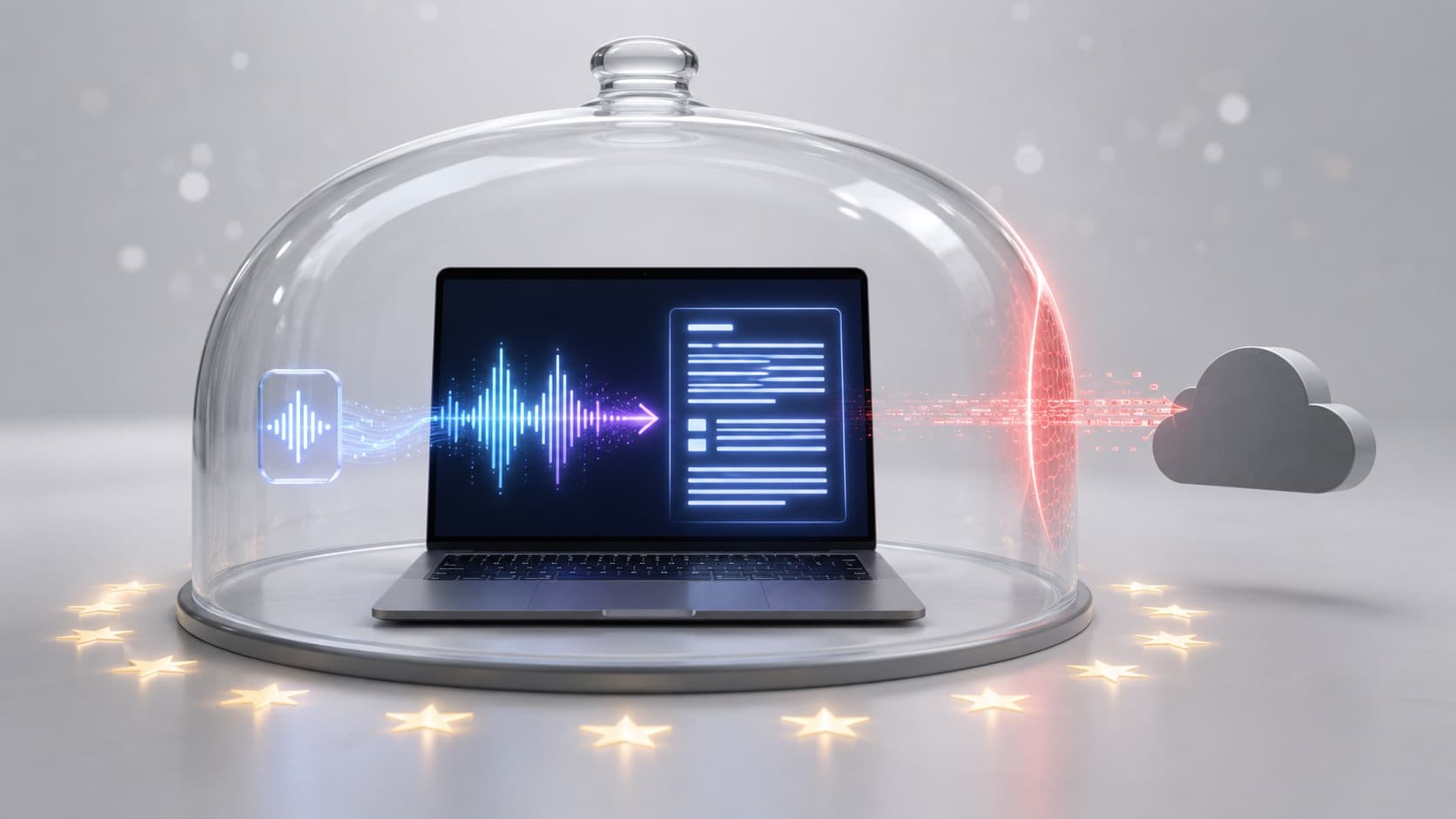
A research interview, a recorded client call, a voice memo full of project notes: AI transcription turns hours of typing into minutes of compute. Which is exactly why countless teams are currently uploading their recordings to some transcription service without asking where that audio actually ends up.
The uncomfortable truth: almost every recording contains personal data, often data in a specially protected category. If you send it to a cloud service outside the European Economic Area (EEA), you must check and secure the third-country transfer on top of having a legal basis for the processing. This article shows what really matters in GDPR-compliant transcription software, which questions you should ask any provider, and why local AI transcription can simplify the review.
A quick note up front: this is a general overview, not legal advice. The concrete assessment always depends on your specific scenario. If you are looking at live dictation rather than transcribing recordings, you will find the legal breakdown in our article on GDPR-compliant dictation software.
Why transcription is a bigger privacy issue than dictation
When you dictate, you process your own voice and your own thoughts. When you transcribe recordings, a decisive dimension is added: other people's data. An interview contains the voice and the statements of your interviewee. A recorded meeting contains the words of every participant. Such voice recordings are regularly personal data. They count as biometric data, a special category under Art. 9 GDPR, only once they are processed with specific technical means to uniquely identify a person.
The content gets sensitive quickly. Qualitative interviews often touch on health, political views, or someone's life story, in other words special categories of personal data under Art. 9 GDPR. Client calls contain contract details, team meetings contain internal and personnel matters. Whoever processes such recordings is responsible for data that other people entrusted to them.
On top of that comes an obligation that applies before any transcription happens: the recording itself needs a legal basis. Recording conversations without the knowledge and consent of the participants is unlawful in many jurisdictions and can even be a criminal offence; several countries and US states require the consent of every party to the conversation. Explicit consent is the safest route in many typical interview and conversation situations; which legal basis actually holds depends on the specific context.
The problem with cloud transcription services
 Illustrative image, AI-generated
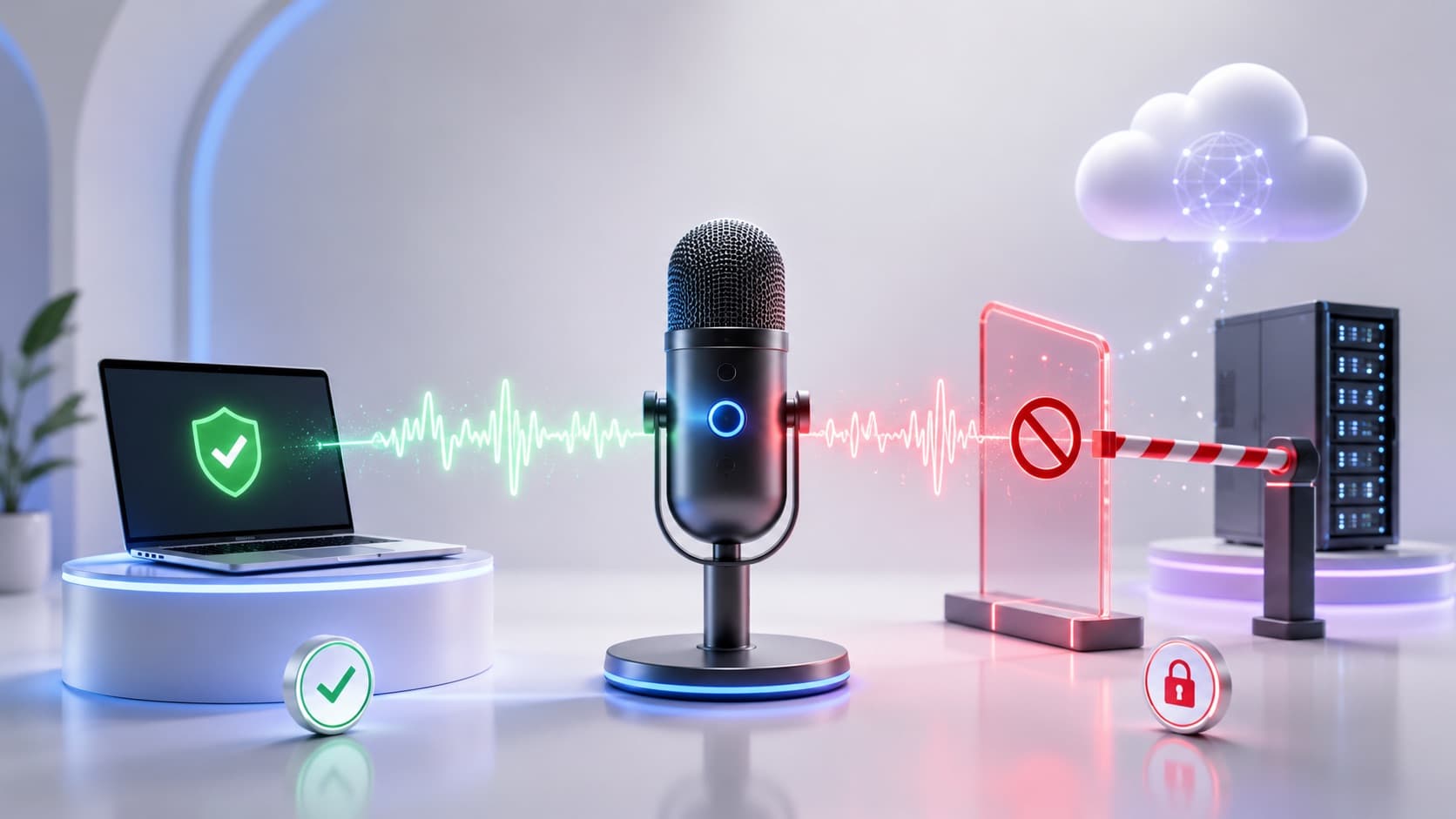
The best-known transcription services are cloud-based, many of them with servers in the United States. That hands you several construction sites at once.
As soon as a provider processes audio on your behalf, you need a data processing agreement under Art. 28 GDPR. If the processing takes place outside the EEA, third-country transfer comes on top, which for US providers requires suitable safeguards and a transfer assessment. For US recipients certified under the EU-US Data Privacy Framework, the European Commission's adequacy decision of 10 July 2023 applies; the EU General Court upheld it in September 2025 and an appeal is pending, so for non-certified recipients standard contractual clauses plus a transfer assessment remain the route. Towards the recorded persons you generally have information duties under Art. 13 and 14 GDPR, unless a statutory exception applies: they must be told about the recipients or categories of recipients of their recording. If you rely on consent, its scope must also cover the planned disclosure and processing.
One point is regularly overlooked here: AI model training. Some services reserve the right to use uploaded audio or transcripts to improve their models. For confidential recordings that is a deal-breaker, regardless of where the server is located. A provider that does not clearly and contractually commit to not using your content for training is not an option for sensitive recordings.
For professionals bound by confidentiality, everything tightens further. Doctors, lawyers, and therapists who disclose client or patient secrets without authorization can face professional and even criminal consequences. An interview with a patient or the recording of a client meeting simply does not belong on the server of a provider you do not have under contractual control.
Local AI transcription: solving the problem at the root
The good news: the technology has fundamentally changed. Modern speech recognition models like Whisper now run directly on ordinary laptops, with no server contact and at a quality that keeps up with cloud services. You can read more about the technology in our guide to offline dictation software for Mac and Windows.
For privacy, that changes everything. If the transcription runs locally on your device, the recording never leaves it. There is no recipient, so no data processing agreement for this step, no third-country transfer, no Schrems II question, and no worry about someone else's model training. Your information duties towards the recorded persons become simpler, because you can truthfully say: the recording stays on this machine.
In qualitative research in particular, this is a practical breakthrough. Ethics boards and data protection officers routinely ask where interview recordings flow. "Transcription runs locally on the study machine" can simplify the data protection review. The same applies to newsrooms protecting sources and to every profession bound by confidentiality.
The honest framing still applies: local solves the transfer question, not every obligation. You still need a legal basis for the recording itself, plus reasonable endpoint security, meaning disk encryption, access control, and a clean deletion routine for recordings you no longer need.
If cloud, then European and switchable
 Illustrative image, AI-generated
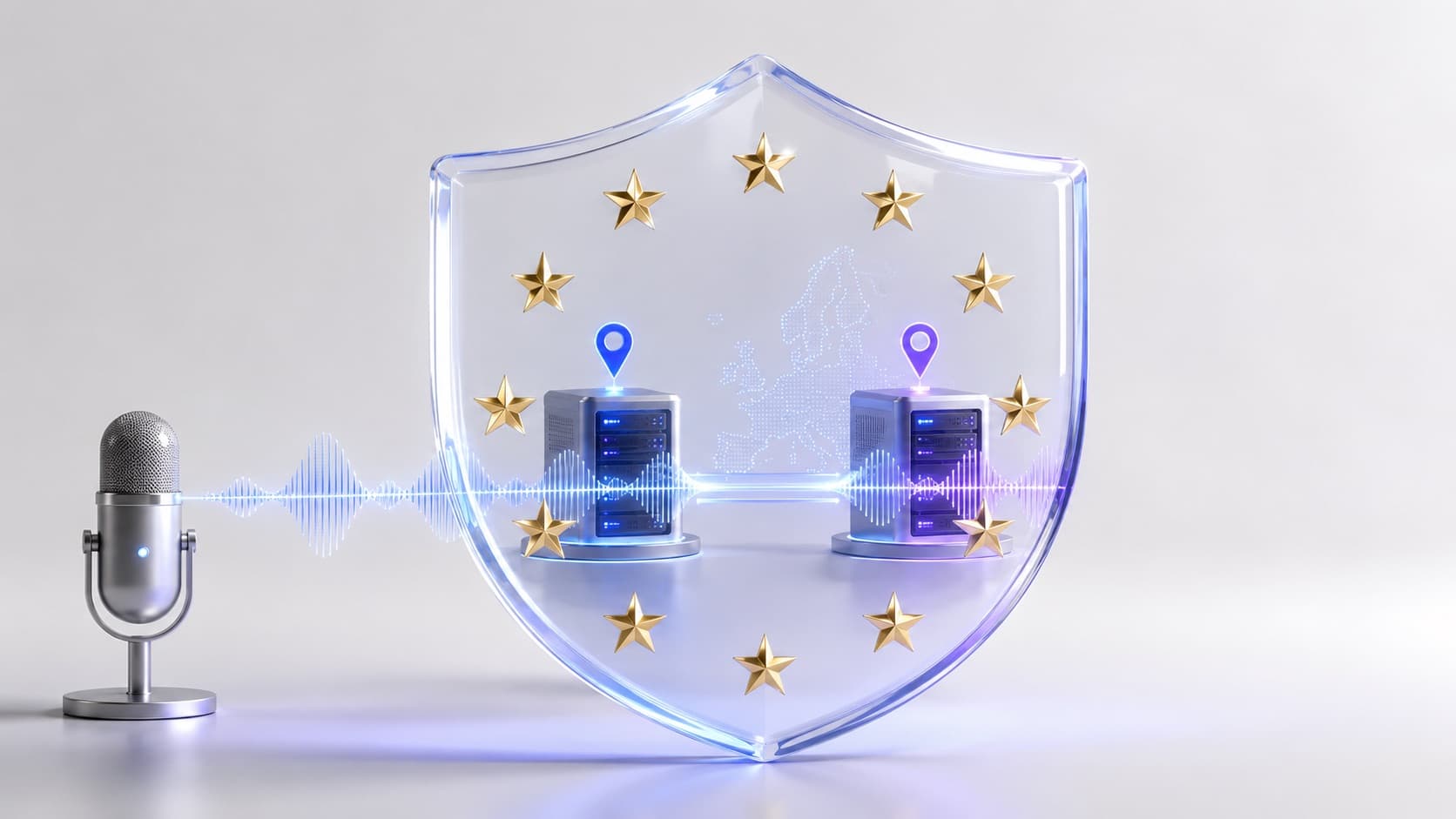
There are cases where cloud compute is genuinely useful, for instance very long recordings on older hardware. Then the question is not "cloud yes or no" but which one. A cloud path that runs entirely within the European Economic Area can simplify the review, but it replaces neither the legal basis nor the other duties. What matters in particular is a data processing agreement, transparent subprocessors, documented retention and deletion periods, appropriate security measures, and a contractual exclusion of use for other purposes such as model training. If the provider promises zero data retention, meaning your audio is not stored after processing, it should also be clearly documented what that covers; not using your content for training is a separate commitment. And you must be able to control whether anything goes to the cloud at all: local by default, cloud only as a deliberate per-feature decision. For comparison, Ownvox transcribes files of up to 6 hours locally and never sends them to its optional cloud.
Checklist: questions for any transcription provider
Before you upload a recording or roll out a tool, these questions should have clean answers. Does transcription run locally by default, or does every piece of audio go to the cloud? If cloud is involved: where are the servers, who are the subprocessors, is there a data processing agreement? Are audio or transcripts used for AI training or stored after processing? Can the cloud be switched off entirely? And finally on your side: which legal basis applies, and have the recorded persons been properly informed?
A provider that answers these questions only with marketing phrases usually does not have them under control. A clear, verifiable statement in the privacy policy is worth more than any slogan.
Frequently asked questions about GDPR and transcription software
Can I transcribe interviews with a US cloud service?
This can be lawful, but it requires checking the specific service and use. You typically need a data processing agreement, a legal basis for the processing, transparency towards the people concerned, and a viable mechanism for the third-country transfer, such as the recipient's certification under the EU-US Data Privacy Framework or standard contractual clauses with the required transfer assessment. Local processing, or processing that stays entirely within the EEA, can avoid the third-country transfer.
Do I need consent from the people who were recorded?
Explicit consent is the safest route for many interviews and recorded conversations, but not the only conceivable legal basis. What matters are the purpose, the context, the data categories, and the applicable statutory rules. Secret recordings are unlawful in many jurisdictions and can be a criminal offence. If you rely on consent, it should also cover the planned further processing.
Is local AI transcription worse than cloud transcription?
Not necessarily. Modern local models like Whisper can deliver a quality that is well usable for interviews, memos, and meetings. The result depends on language, recording quality, hardware, and model; the most reliable check is a test with your own material. On older hardware, a suitably secured cloud service can be a sensible compromise.
What does zero data retention mean?
That the provider does not store the audio and transcripts covered by the commitment permanently after processing. Whether content is also kept out of model training or other uses of its own should be regulated separately and explicitly. For confidential recordings, the scope and any exceptions should be documented in the contract.
Is an EU server location enough for GDPR compliance?
No. A server location in the EEA can only avoid the third-country transfer if the rest of the processing chain and any relevant access also stay in the EEA; remote access from a third country can itself be a transfer. You still need a legal basis, where applicable a data processing agreement, transparency about subprocessors, appropriate security measures, and clear rules on storage and model training.
What applies to doctors, lawyers, and other professions bound by secrecy?
For them the bar is highest: unauthorized disclosure of professional secrets carries professional and often criminal consequences. Recordings involving patients or clients should ideally never leave a device under your own control. Local transcription is often the only clean path here.
Conclusion: local processing avoids an additional transfer
GDPR-compliant transcription starts before the first upload: with a viable legal basis, the required information for the people concerned, and the question of whether the recording needs to leave your device at all. If the AI transcription runs locally, the obligations around an external processor and a possible third-country transfer fall away for this processing step. If you do need cloud compute, check the processing chain, contracts, retention periods, security measures, and any use for model training concretely.
Ownvox: local AI transcription, built in Germany
Ownvox follows exactly this principle and covers both halves of the job. For live dictation, it turns your voice into text as soon as you stop speaking and inserts the finished text right at the cursor in any app. For recordings, the Transcripts tab takes your files, for example an interview, a meeting you recorded yourself, or a voice memo in a supported format (mp3, wav, m4a, aac, flac, ogg, mp4, mov, mkv, with only the audio track used for video), and returns the text. Several files can be queued and are worked through one after another, each up to 6 hours long, and you can copy the result, save it as .txt or .md, or find it again in the transcript history. Speech recognition runs locally on your Mac or Windows machine by default, and file transcription always does: it never goes through the cloud, not even when the optional cloud is switched on for dictation, so your recording stays on your device. One honest limit for interview work: Ownvox does not label speakers and does not add timestamps, so you get a plain text transcript that you structure yourself. Optionally you can enable an EU cloud, whose inference runs in France at Scaleway and whose proxy runs in Germany at Hetzner. This path is configured for zero data retention, and your content is not used for model training. A privacy switch disables all cloud functions with one click, a data processing agreement is available, and Ownvox is developed in Germany.
If you are looking for speech recognition whose local default technically supports data protection requirements, download Ownvox and transcribe your first recording locally on your machine.